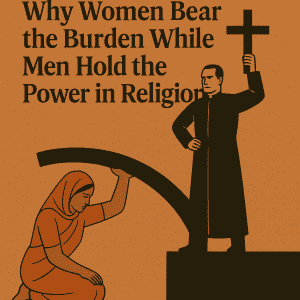
We live in a world where the idea of gender equality is often celebrated—at least in words. But when you look closely at the deeply rooted structures of religion, a different picture emerges. Across nearly every faith, one thing is consistent: men occupy the positions of power and authority, while women are handed the burden of rituals, responsibilities, and silent devotion.
From daily religious duties to exclusion from leadership, women are often expected to do the spiritual heavy lifting, but their contributions are rarely recognized with real influence. This article is not an attack on faith—it’s a call to examine how faith is practiced and how deeply gendered those practices often are.
The Unequal Division: Power vs. Piety
In Hinduism, men are the priests, gurus, and temple heads (Pew Research Center, 2016). Women, meanwhile, are the ones waking up early, lighting the lamps, keeping the fasts, and praying endlessly for the family’s well-being. Karva Chauth, Hartalika Teej, and Vat Savitri are just a few of the fasts women undertake—glorified by culture, but physically and emotionally demanding (India Today, 2017).
Islam shows a similar divide. While both men and women are called to pray, men occupy every significant religious position: imams, qazis, scholars. Women often pray in segregated spaces or are barred from mosques entirely in certain regions (Encyclopedia of Islam and the Muslim World, 2004).
Christianity, particularly the Catholic Church, also limits women’s participation in leadership. Women can become nuns, but they cannot be ordained as priests, and the highest position—the Pope—is permanently out of reach for women (Reuters, 2023).
Menstrual Taboos: The Silent Exile
Perhaps one of the clearest markers of religious gender disparity is the treatment of menstruation. In Hinduism, menstruating women are barred from entering temples or participating in rituals (NCBI, 2020). Orthodox Judaism maintains the concept of ‘Niddah’, where menstruating women abstain from certain religious activities (My Jewish Learning). Islam also exempts menstruating women from fasting and prayer (Islamic Jurisprudence).
The Sabarimala temple in Kerala, India, banned women aged 10–50 until the Supreme Court lifted the ban in 2018 (BBC News, 2018)—though fierce resistance followed, showing how entrenched these beliefs are.
The Marginalization of Widows
In some Hindu communities, widows are seen as inauspicious, often barred from participating in festivals and religious ceremonies (National Geographic, 2017). Historically, Christianity also imposed celibacy expectations on widows, particularly in early Church history (Encyclopedia of Early Christianity, 1997).
Lesser-Known but Telling Examples
Japan’s Shinto Faith: Women serve as miko (shrine maidens) but hold subordinate roles compared to male priests (Japan Times, 2019).
Nepal’s Kumari Tradition: Girls worshipped as “living goddesses” are dismissed after menstruation, marking them as impure (The Guardian, 2015).
Buddhism: Bhikkhuni (female monk) ordination has faced significant challenges in Theravāda Buddhism (Buddhistdoor Global, 2018).
Ethiopian Orthodox Church: Women are restricted from entering sanctuaries during menstruation and post-childbirth (Journal of Religion in Africa, 2012).
When Women Carry the Rituals, But Men Hold the Rules
The pattern is undeniable: women are tasked with upholding religious practices at home and in personal life, but men dominate public religious spaces and decision-making roles (Pew Research Center, 2016). This imbalance influences not just spirituality but the societal norms and laws shaped by these religious bodies.
The Push for Change: Small Steps, Big Dreams
Reform Judaism ordains women rabbis (Jewish Virtual Library), the Anglican Church now has women bishops (BBC News, 2014), and Muslim feminist groups like Musawah push for more inclusive readings of religious texts (Musawah Official Site). In India, figures like Trupti Desai have fought for women’s rights to enter temples and perform rituals (The Hindu, 2020).
A Personal Reflection: Rethinking Faith and Equality
What strikes me most as I explore these patterns is how normalized this inequality has become. We’re told it’s tradition, it’s sacred, it’s always been this way. But faith should be a force for unity, not division—a space for justice, not hierarchy.
We need a world where women don’t just carry out rituals but also shape spiritual leadership and policy. A faith that uplifts all equally is the faith worth fighting for.